

James Howden
1832 – 1913
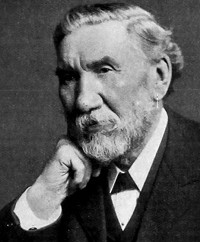
Marine engineer whose inventive genius and flair for business helped transform the 19th Century Scottish economy
Engineering Achievements
James Howden was one of Scotland’s most influential industrial engineers of the late nineteenth century. Through sustained technical innovation, most notably the invention of the Howden Forced Draught System, he fundamentally transformed marine propulsion efficiency, global shipping economics, and early power generation practice. His work saved millions of tonnes of coal annually, enabled faster and longer ocean voyages, and underpinned Scotland’s emergence as a global centre of marine engineering excellence.
Howden’s most influential achievement was the development of a forced draught combustion system that used waste flue‑gas heat to pre‑heat combustion air, delivered under pressure by mechanically driven fans. After decades of experimentation, the definitive system was patented in 1882.Technically, this innovation increased combustion efficiency, reduced coal consumption dramatically and enabled higher, sustained boiler outputs without proportionate increases in size or fuel.
The Howden Forced Draught System was rapidly adopted by shipbuilders worldwide. Within a decade over 1,000 marine boilers were either converted or newly built to Howden’s design. The first ship fitted under sea‑going conditions was the City of New York, whose trials demonstrated simultaneous increases in power and reductions in fuel consumption, a result previously thought unattainable. She went on to win the Blue Riband (for fastest crossings of the Atlantic.)
The system was installed on some of the world’s most famous liners, including RMS Lusitania and RMS Mauretania, which became the fastest ships afloat, both Blue Riband winners, after ten years of German domination.
Contemporary and later analyses credit Howden’s system with saving an estimated 15 million tonnes of coal annually worldwide during its peak adoption period, a contribution of global economic and environmental significance.
Beyond forced draught, Howden patented innovations across: Steam engine valve gear and compounding; Air pre‑heating and heat recovery; Mechanical draught fans (early axial‑flow, turbine‑driven designs); High‑speed engines for electricity generation (late career).
He continually revisited earlier concepts, refining ideas across decades, demonstrating exceptional technical persistence and systems thinking.
His Life
-
1832 Born on 29 February in Prestonpans, East Lothian, the son of James Howden, market gardener, and Catherine Adams
-
1837-47 Age: 5-15 Educated at Prestonpans parish school
-
1847 Age: 15 Travelled to Glasgow (by boat through Forth & Clyde Canal), to be an apprentice in James Gray & Co., builders of stationary engines.
-
app 1852 Age: 20 Appointed Chief Draughtsman of James Gray & Co, whilst still an apprentice
-
app. 1853 Age: 21 employed by Bell and Miller, civil engineers, then Robert Griffiths, marine screw propeller designers
-
1854 Age: 22 Set up as an independent consulting engineer in Glasgow.
-
1857 Age: 25 one of the founding members of the Institution of Engineers in Scotland
-
1859 Age: 27 Won first major contract to provide compound engines and water tube boilers for the Anchor Line's ship 'Ailsa Craig'.
-
1862 Age: 30 Established James Howden & Co manufacturing works in Scotland Street, Glasgow in partnership with James Mathie.
-
1882 Age: 50 Patented the Howden Forced Draught System for marine boilers
-
1888 Age: 56 Launch of 'City of New York' fitted with Howden forced draught boiler systems
-
1898 Age: 66 New and larger factory built at 195 Scotland Street
-
1906 Age: 74 Launches of 'RMS Lusitania' and 'RMS Mauretania' fitted with Howden forced draught boiler systems
-
1907 Age: 75 Howden becomes a private limited company with James Howden as Chairman, and his nephew James Howden Hume as managing director
-
1913 Age: 81 Died on 21 November in Glasgow
His Legacy
Howden was one of that enterprising group of engineers whose inventive genius and flair for business transformed the Scottish economy in the second half of the nineteenth century. He established a technological lineage that shaped marine propulsion, land‑based power generation, and industrial air‑handling systems well into the twentieth century. His invention of the forced draught system boilers saved millions of tons of coal.
James Howden & Company went on to play pivotal roles in electricity infrastructure, energy‑efficiency technologies and wartime production. During World War I, the Admiralty ruled that, "all ships were to be fitted with Howden blowers so that they could outrun the U-boats."
More Information
Oxford Dictionary of National Biography. James Howden by Charles W. Munn, 2004. [free to UK Library subscribers]
Douglas Hume a personal story by David H. Hume, Published in aid of the June and Douglas Hume Memorial Fund administered by Foundation Scotland, ISBN 978-1-905989-88-1, Printed by Nicholson & Bass Ltd., Belfast. (2008).
A Hundred Years of Howden Engineering. Crawford W Hume, James Howden & Co Ltd. (1954)
Selection of Patents:
- 1854 – Improvements in rivet and fastener manufacture
- 1857 – Improvements in Motive Power (Jointly with Alexander Morton)
- 1860 – Pre‑heating combustion air and boiler efficiency improvements
- 1882 – Howden System of Forced Draught
-

A Howden steam engine, 1864
-

James Howden from "The Baillie", 1895
-

James Howden from "The Engineer", 1913
-

195 Scotland Street premises in 1951
-

Howden and Siemens Brothers 6000kW Turbo-Alternator (with top covering removed)
-

Howden sales blurb from 1921